
Absolute Lotus magazine
July/August 2026 – Issue 51

Esthi 2.3 – The German Lotus importer’s forgotten 205mph Elise
Type 47 ‘Snorkel Lotus’ – The story of the ex-works Europa-based racer
Esprit – How to make a 1980s Esprit electrics reliable
Mike Watkins interview – Could the F3 driver have made the grade for F1?
Highland Tour – The best roads in Scotland in a fleet of Lotuses
Great Race – How it was privateers that kick-started Elite success at Le Mans
Life in Lotus – Patrick Limming owned a string of Lotuses before settling on an Elise keeper
…and much more!

How Lotus’s German importer turned the Elise into a supercar
Have you ever heard of the Lotus Esthi 2.3? It was devised just after the turn of the millennium by Lotus’s biggest dealership in Germany as a supercar-hunting Elise derivative with the target of topping 200mph. And because the company behind it had close ties with Hethel, they were even permitted to use the Lotus logo in marketing material.
As well as a twin-turbocharged 2.7-litre V6 engine from an Audi RS4 (the 2.3 didn’t relate to engine capacity…), the Esthi also has revised bodywork that was tweaked in Porsche’s wind tunnel, changes to the chassis geometry and the ABS brakes from a contemporary Esprit. Sadly, plans to build 20 cars (ten for the road and ten for the track) never reached fruition and only the single development car was ever completed.
In UK ownership, this rare piece of Lotus history had just been returned to the road and the full story – including the remarkable tale of how its current keeper came to own it – is in Issue 51 of Absolute Lotus.

When is a Europa not a Europa?
The Lotus Europa was billed as a clubman racer to take the place of the Seven, which meant a racing version was a natural development. Lotus Components offered the Type 47 for those who wanted to go racing and, while it looked much like a Europa road car, the bodywork was lighter and there were changes to the chassis.
Arguably the most famous Type 47 was the works ‘Snorkel Lotus’, so known because its pair of over-the-roof that were there to feed the induction and cool the exhaust. After being sold off, it went into club racing where a severe crash saw the body/chassis replaced, and it eventually ended up in a scrapyard. Pat Thomas, the now retired founder of Kelvedon Motors, bought it more than 40 years ago and restored it to the works spec, before spending a season racing it earlier this millennium.
The car has had its ups and downs, but now serves as a glimpse into Lotus racing past that often lives in the shadows of higher ranking formulae. It’s in Issue 51 of Absolute Lotus.
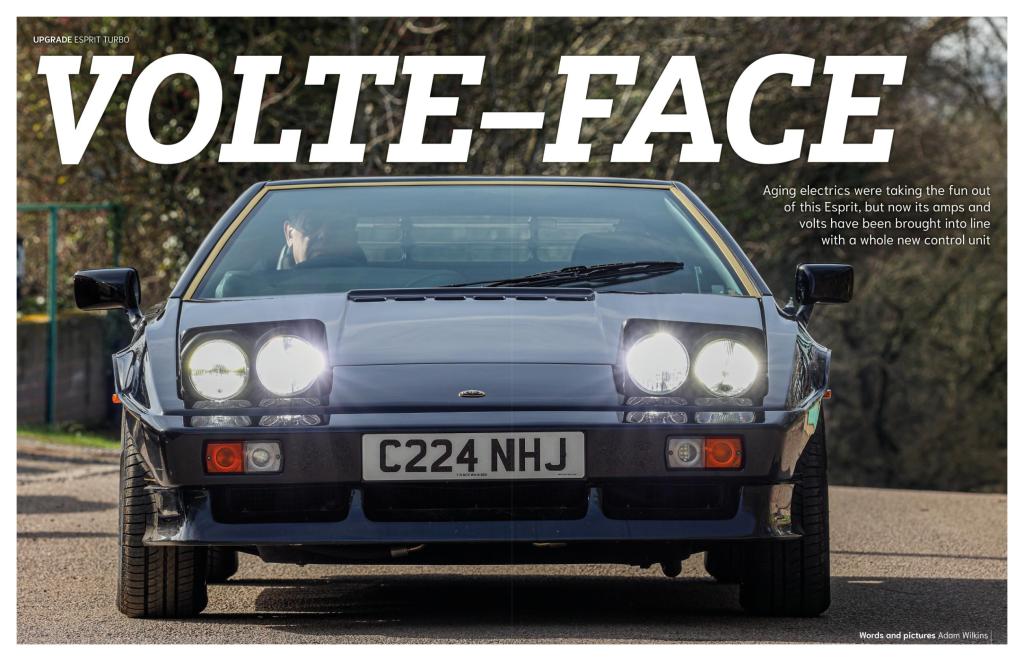
How to make 1980s wiring suitable for the 21st century
Alan Woosey isn’t a man who’s concerned with maintaining originality. You only need to look at the retrimmed interior of his Turbo Esprit to draw that conclusion. His aim for classic car ownership is to develop cars to make them dependable for regular use, which is why his car has had a wholesale replacement of its electrical system.
“People are realising that electrics are one of the main weaknesses of ’70s and ’80s cars,” said Mike Taylor, who did the work. It’s a big job, and it’s not cheap, but the transformation is significant, boosting reliability, security and safety. The results are explained in full in Issue 51.
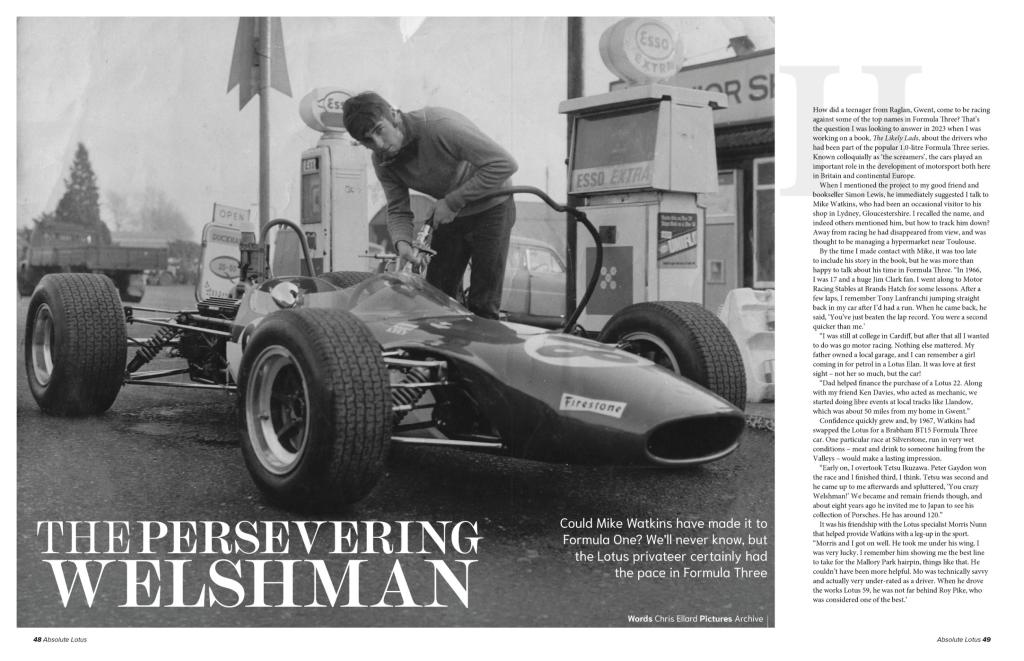
Could Mike Watkins have made it to Formula One?
Welsh privateer racer Mike Watkins showed plenty of pace during his time competing in Formula Three, but the leap to motorsport’s top tier takes more than just talent. Fortune, funding and connections also play their part in ascending single-seater formulae.
Having left racing behind some decades ago, he reflects on the rollercoaster career in an interview with journalist and author Chris Ellard in Issue 51. Tales include racing against the likes of Emerson Fittipaldi and James Hunt, as well as testing his open-wheeled Lotus on an newly built and unopened stretch of motorway. Things were different back then…

Adventure in the Highlands
The Scottish Highlands are a playground for Lotus drivers, and for this year’s edition of our annual tour we went further north than ever before and found some spectacular roads that looked like they were made for a Lotus. Though of course it’s actually the other way around.
With a fleet of eight Lotuses, we explored mountains and glens, stopping at a range of excellent lunch and overnight venues. When we called in at Inverary Castle, tourists turned their camera lenses away from the historic backdrop and towards our line-up for a while, while the Isle of Eriska is a hidden gem of a private island. Relive the experience with us in Issue 51.
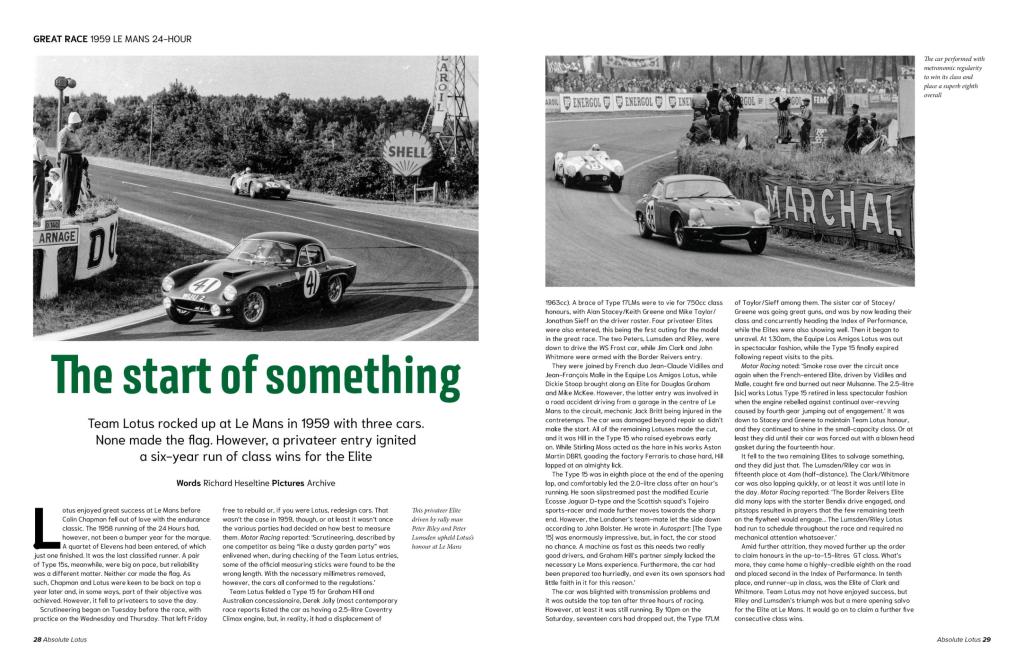
How it was privateers that first proved the Elite’s mettle at Le Mans
The Elite Type 14 punched above its weight from the moment it was launched and followed it up with a six-year run of class wins at the Le Mans 24-hour. Yet despite the fact that Team Lotus took no fewer than three cars to La Sarthe in 1959, none of them lasted the distance. It was a privately-entered car that claimed the first of that run of victories, as Richard Heseltine tells us in Issue 51’s Great Race.

A life in Lotus
Like so many Lotus enthusiasts, Patrick Limming was bitten by the big at a young age. As a child, he saw his first Elan as an unassembled kit on a trailer and knew one day he would own one. He achieved the dream, and then moved on to a string of Esprits.
His wedge era came to an end when Lotus announced the Elise, and was one of the very first people to take delivery of one in 1996. Since then, he hasn’t looked back and still owns that car today. His Life in Lotus story is in Issue 51.
Click here to order your copy. Worldwide delivery and free shipping to UK addresses.
 Absolute Lotus