
It’s not often we see a concept car from Lotus, but in these changing times the company has seen fit to outline its future sports car direction with the Theory 1, a not-for-production electric sports car that dispenses with the convention of naming its cars with a Type number or a word with the letter E. It’s also, Evija hypercar aside, our first glimpse at what we can expect of an electric Lotus sports car.
Lotus describes the The Lotus Theory, revealed alongside the Theory 1, as its ‘new design manifesto’ and says that all future models will be guided by three core principles: digital, natural and analogue (neatly initialised as DNA). Cutting edge digital technology may be something we’re still getting used to from Lotus, but it’s going to be central to its future offerings. Innovations piloted in the Theory 1 concept car will become a reality in future Lotus models.
Ben Payne, Vice President of Design, Lotus Group said: “We want to demonstrate that you don’t need to compromise – with both digital and analogue capabilities working harmoniously in the future car. In doing this, we are able to bring drivers the best possible immersive driving experience with raw emotion, functionality and connectivity, at the core.”
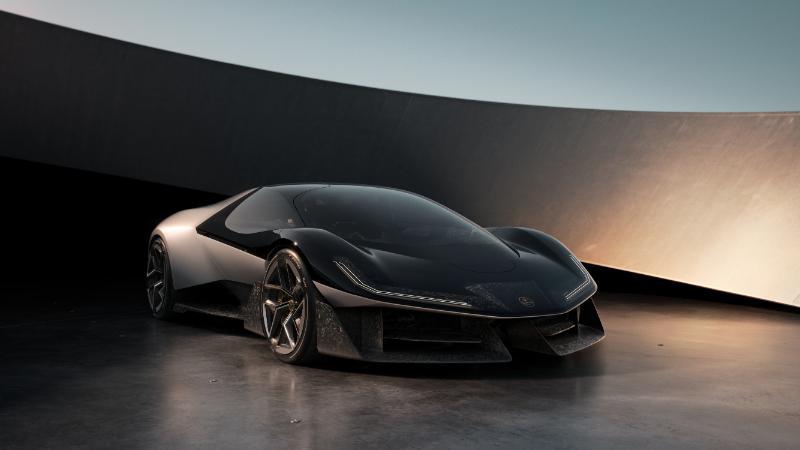
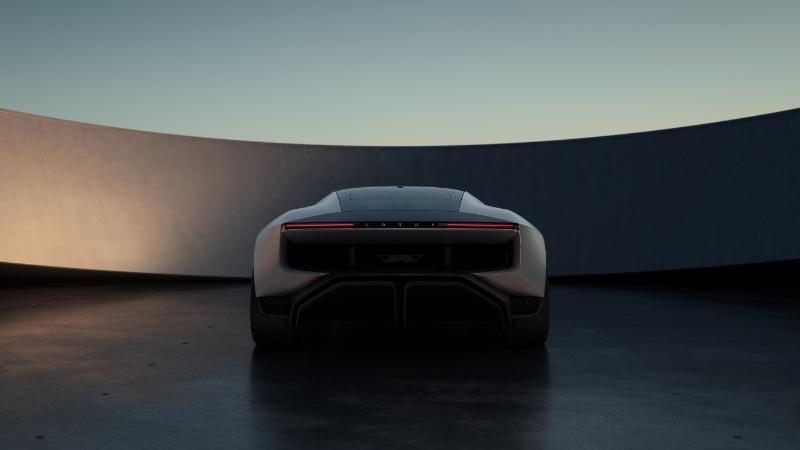
The wedge shape is said to be a nod to the Esprit without taking direct inspiration from the Giugiaro-penned classic. Active and passive aerodynamic features aid cooling and include an active spoiler and passive underbody. The latter is contoured to direct air through NACA ducts for cooling. Up front there’s a diffuser and drag-reducing air deflectors, while the sidepods have been designed to isolate the turbulent wake from the attached airflow and guide it to the rear of the car. There’s no mention of the word ‘porosity’ in the official press release, which was a fundamental principle of the Evija the was carried over to the Eletre.
The 986bhp motor and 70kW battery are incorporated into the car as stressed members, inspiration coming from the Type 49 grand prix car. This eliminates the need for a subframe in the name of weight-saving, the Theory 1 tipping the scales at something below 1600kg. While we’re talking figures, the quoted to speed is 198mph and the 0-60mph time is below 2.5sec. The WLTP combined range is 250 miles. At 4490mm long and 2000mm wide, the Theory 1 only slightly larger than an Emira (4413mm by 1985mm).
Lotuswear is the company’s own proprietary system, an element of which was developed in collaboration with MotorSkins. It gives each occupant of the car their own personalised experienced. Using a lightweight robotic textile material, it communicates with the driver and passengers in subtle ways. For instance, inflatable pods on the seat and steering wheel will react to give more support and grip, as well as subtle prompts to the driver by pulsing on the left and right sides of the steering wheel when the driver should make a turn.

In addition, Theory 1 has five driving modes (Range, Tour, Sport, Individual and Track) that optimise efficiency, performance and comfort on demand, as well as adapting constantly to the surrounding environment. You can’t deny it’s all a far cry from the simple analogue appeal of an Elan or an Elise, but it’s part of Lotus’s fulfilment of Vision80 to become a global performance technology brand.
Another element of Lotuswear is the 3D printed lattice structure headrests made in partnership with a company called Carbon. These promise to reduce weight and improve material efficiency while being able to vary their physical form. The headrests also include a binaural audio system – which separates the sound arriving at each ear – developed by established Lotus partner KEF. These means each occupant can listen to a bespoke soundscape, choosing to enhance ‘speed sounds’ or cancel outside noise.
The Lotuswear Technology line – featured on the flanks – includes a 360-degree autonomous driving suite that includes embedded L4 hardware capability, which isn’t yet legal to use in most markets, similar to that already seen on the Eletre and Emeya. It is built on the high-performance Nvidia Drive platform – enabling redundant and diverse real-time sensor processing at trillions of operations per second It provides a built-in self-driving function, even though legislation currently doesn’t allow it to be used.
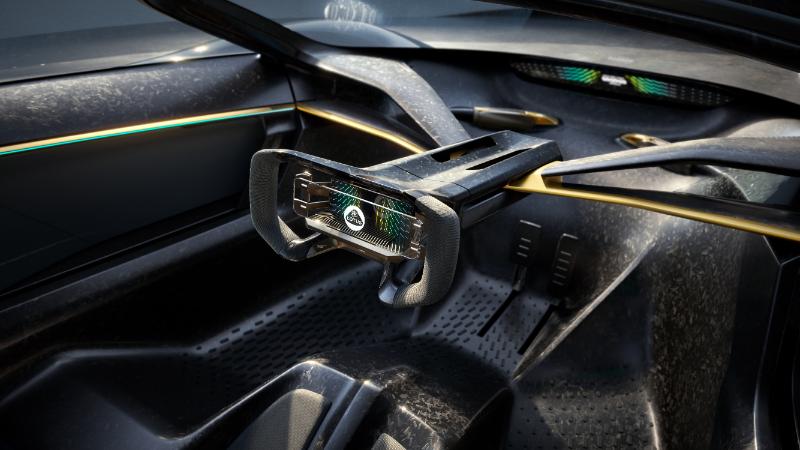
This may all start to sound at odds with Lotus’s ‘for the drivers’ mantra, but some of the technology is there to assist with allowing the driver to concentrate on the job in hand. For instance, LEDs that are visible inside the car light up red or green depending on the need for braking or acceleration. Meanwhile, there are 2D graphics on the steering wheel to relay the main data. Minimal typefaces and graphical elements are used for clarity – something that’s lacking in many modern cars. It’s easily taken in by the driver using their peripheral vision, allowing them to keep their eyes on the road more of the time.
This is probably a good time to mention that the Theory 1 is a three-seater with a central driving position. Lotus cites motorsport as its inspiration, but we’re all thinking McLaren F1. The seat is fixed and the steering wheel and pedals move to the driver, an arrangement so logical you wonder why that’s not the case with all cars.

Another area of focus for the Theory 1 was to use as few surface materials as possible. ‘Challenge of 10’ was the name given to Lotus’s drive to use just ten surface materials, a nod to the minimalism of the marque’s past while aiming for 21st century sustainability. The chassis tub is made from recycled chop carbonfibre while the body is cellulose composite and polycarbonate. The glass is recycled.
Elsewhere, the company has worked with Kyocera SLD Laser Inc to create laser lights both inside and outside the car. The result is vastly reduced component size: the laser wire daytime running lights are less than a millimetre in diameter while the main and dipped beam headlights use lenses of just 7mm by 35mm. Brands we’re more familiar with include AP Racing for the 6-piston brake calipers and Pirelli for the P-Zero Elect tyres (20in at the front, 21in at the back).
After two ‘lifestyle’ vehicles in a row in the form of the Eletra and Emeya, the Theory 1 gives us our first taste of what’s to come with an electric Lotus sports car that’s more within reach than the rarefied Evija hypercar. The EV future is one that many enthusiasts will struggle to reconcile, but if the dynamic ability of Lotus’s 2.6-tonne SUV is a hint at what’s possible with something (relatively) lighter and (much) lower, we’re intrigued to see what transpires.
Absolute Lotus is the bi-monthly magazine for Lotus owners and enthusiasts. For your regular fix of Lotus content, subscribe here
 Absolute Lotus